Why Investment Casting Remains Critical
Turbine blades and vanes operate in some of the most demanding environments in an aircraft engine.
The components can require complex aerodynamic surfaces, thin walls, internal cooling passages and high-temperature nickel-based superalloys.
Investment casting remains a fundamental manufacturing process because it can create geometries difficult or uneconomic to produce directly through conventional machining.
NASA documents describe single-crystal nickel-superalloy turbine components as being produced through high-gradient investment casting, with ceramic cores used to create internal cooling cavities.
The Process
The production chain begins with tooling used to create a wax or polymer pattern.
For cooled blades, a ceramic core is positioned inside the pattern tooling before wax injection. The pattern defines the external geometry; the core eventually defines the internal cooling passages.
Patterns are assembled into a cluster or tree.
The cluster is repeatedly dipped into ceramic slurry and coated with refractory particles to gradually build a shell mold. ASM describes shell production, pattern removal, mold firing, melting, casting, post-casting processing and inspection as major stages of the investment-casting process.
After the shell has developed sufficient strength, the wax is removed and the mold fired.
Molten superalloy is then poured into the mold.
After solidification, the ceramic shell and internal core material are removed. Components are separated from the gating system and undergo cleaning, heat treatment, machining and inspection.
Directionally Solidified and Single-Crystal Blades
The highest-temperature turbine applications may use directionally solidified or single-crystal structures.
For single-crystal blades, the manufacturing challenge is not merely filling the mold. The solidification process must control crystal growth.
NASA describes directional solidification using a controlled thermal gradient and a grain selector that allows the desired crystal to propagate into the component.
That requirement makes the process considerably more sensitive than conventional casting.
Common Challenges
ASM identifies issues including inclusions, porosity, distortion, core shift and problems associated with core removal as important investment-casting concerns.
For turbine airfoils, small manufacturing deviations can affect internal cooling passages or aerodynamic surfaces.
Shell consistency is particularly important. Slurry properties, coating thickness, drying conditions and handling all contribute to mold quality.
Where Automation Adds Value
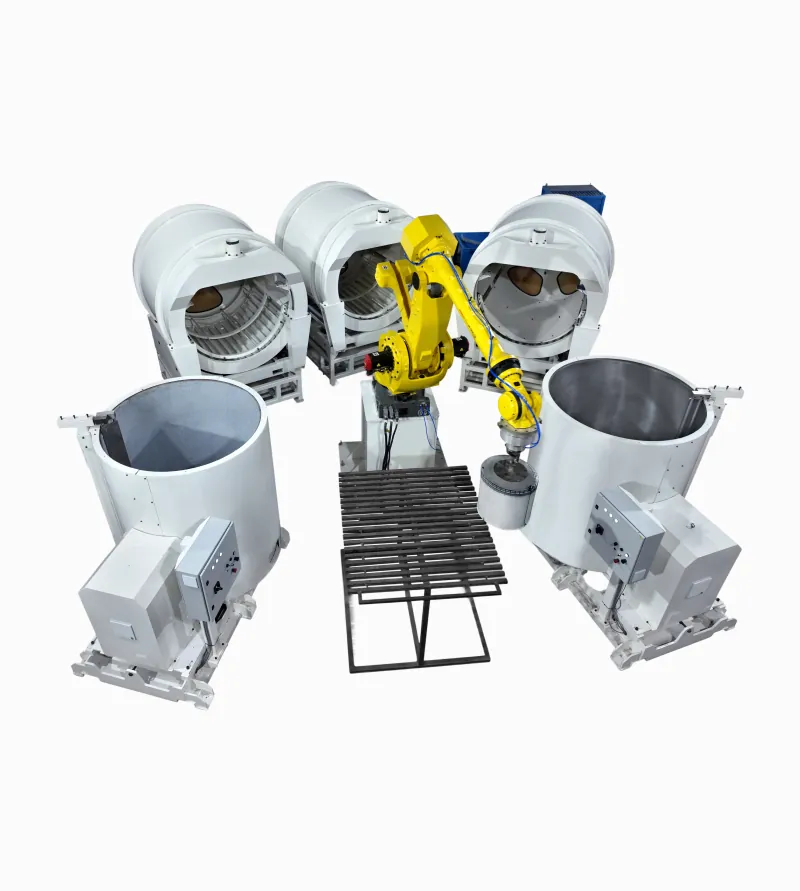
Robotic Shell Building
Shell production is repetitive and process-sensitive.
Robotic systems can consistently control pattern movement through slurry, draining, stucco application and handling between operations.
The value is not simply labor reduction. Automation can improve repeatability between shells.
Automated Material Handling
Robotics can move wax assemblies and molds between operations while minimizing repetitive manual handling.
Digital Process Monitoring
Foundries increasingly benefit from monitoring slurry condition, temperature, humidity, furnace conditions and other variables that influence final quality.
Inspection
Machine vision, dimensional metrology, fluorescent penetrant inspection and radiographic inspection can detect defects or deviations before downstream value is added.
Process Modeling
Modern aerospace casting increasingly incorporates solidification modeling. A 2025 ASM technical article notes the use of modeling and integrated computational materials engineering to improve development and optimize casting conditions for advanced aerospace components.
Automation Does Not Remove Metallurgy
Investment casting demonstrates an important manufacturing principle.
Automation can make a process more repeatable, but it cannot compensate for weak process engineering.
Successful automated casting still depends on controlling materials, shell chemistry, thermal gradients, core behavior, alloy composition and solidification.
Conclusion
Investment casting remains indispensable because turbine blades and vanes combine geometry, materials and operating conditions that are extraordinarily difficult to satisfy.
The future of the process is therefore unlikely to be the replacement of investment casting.
It is the digitization and automation of investment casting—using robotics, monitoring, modeling and inspection to improve yield, consistency and throughput.