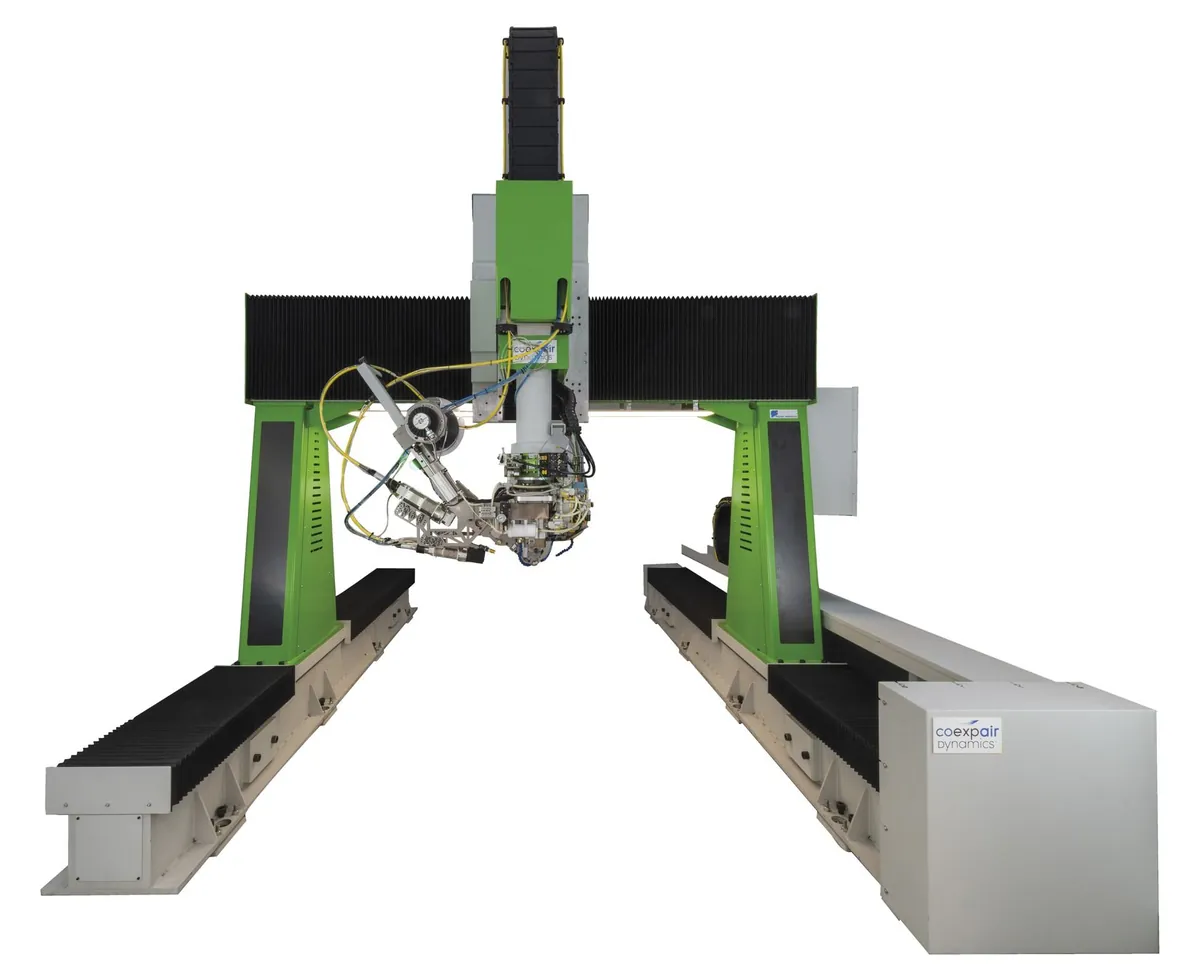
AFP and ATL both automate the placement of pre-impregnated composite material, but they are optimized for different geometries and production strategies.
NASA describes automated tape laying and automated fiber placement as important manufacturing methods for thermoplastic and thermoset aerospace structures.
Automated Tape Laying
ATL generally places relatively wide tape onto a tool surface.
Its strength is productivity on broad, relatively simple surfaces.
Large wing skins, panels and other gently contoured structures can benefit because a wide tape covers significant area during each pass.
ATL can therefore be highly efficient when geometry does not require frequent steering or local variation.
Automated Fiber Placement
AFP places multiple narrow tows rather than a single wide tape.
Individual tows can often be started and stopped independently, enabling the machine to tailor material placement to complex contours and varying laminate geometry.
NASA has described AFP as a major manufacturing approach for large aerospace composite structures and notes its ability to create complex shapes consistently and repeatably.
This flexibility generally makes AFP better suited to:
complex curvature, localized reinforcement, tapered laminates and geometries requiring variable material coverage.
The Fundamental Tradeoff
ATL emphasizes coverage rate.
AFP emphasizes geometric flexibility.
That distinction does not mean one technology is always faster or more sophisticated. Actual productivity depends on part geometry, material width, machine configuration, tow count, head speed, inspection requirements and layup strategy.
Defect Control
Automated composite placement does not eliminate defects.
NASA research identifies gaps, laps, overlaps and tow/tape placement irregularities as important AFP quality considerations.
That has driven development of in-situ inspection technologies capable of monitoring material placement during manufacturing rather than relying exclusively on manual inspection after each layer.
Thermoplastic Opportunity
Thermoplastic composites are creating another important development path.
NASA's HiCAM research has investigated laser-assisted in-situ consolidation during AFP as a means of increasing composite manufacturing rate. In this approach, heat is applied at the material interface while a roller consolidates the layers.
If sufficiently mature for an application, in-situ consolidation may reduce dependence on lengthy secondary cure cycles.
How to Choose
ATL becomes attractive when:
the component is large, relatively flat or gently curved, high area coverage is important and wide tape can be laid efficiently.
AFP becomes attractive when:
the component contains significant contour, tow steering, variable thickness, complex fiber paths or localized reinforcement.
Many aerospace manufacturers ultimately require both approaches because the aircraft itself contains both geometry types.
Equipment Selection Beyond the Head
An AFP or ATL investment should consider much more than deposition speed.
Buyers should evaluate machine working envelope, number and width of tows, material compatibility, heating method, compaction control, head accessibility, tool geometry, software, simulation, inspection, material storage and post-layup cure requirements.
Conclusion
The AFP-versus-ATL decision is fundamentally a geometry-and-production decision.
ATL maximizes efficiency when broad surfaces dominate. AFP provides greater flexibility when complex fiber placement dominates.
The most capable composite factory selects the placement architecture around the structure—not the other way around.